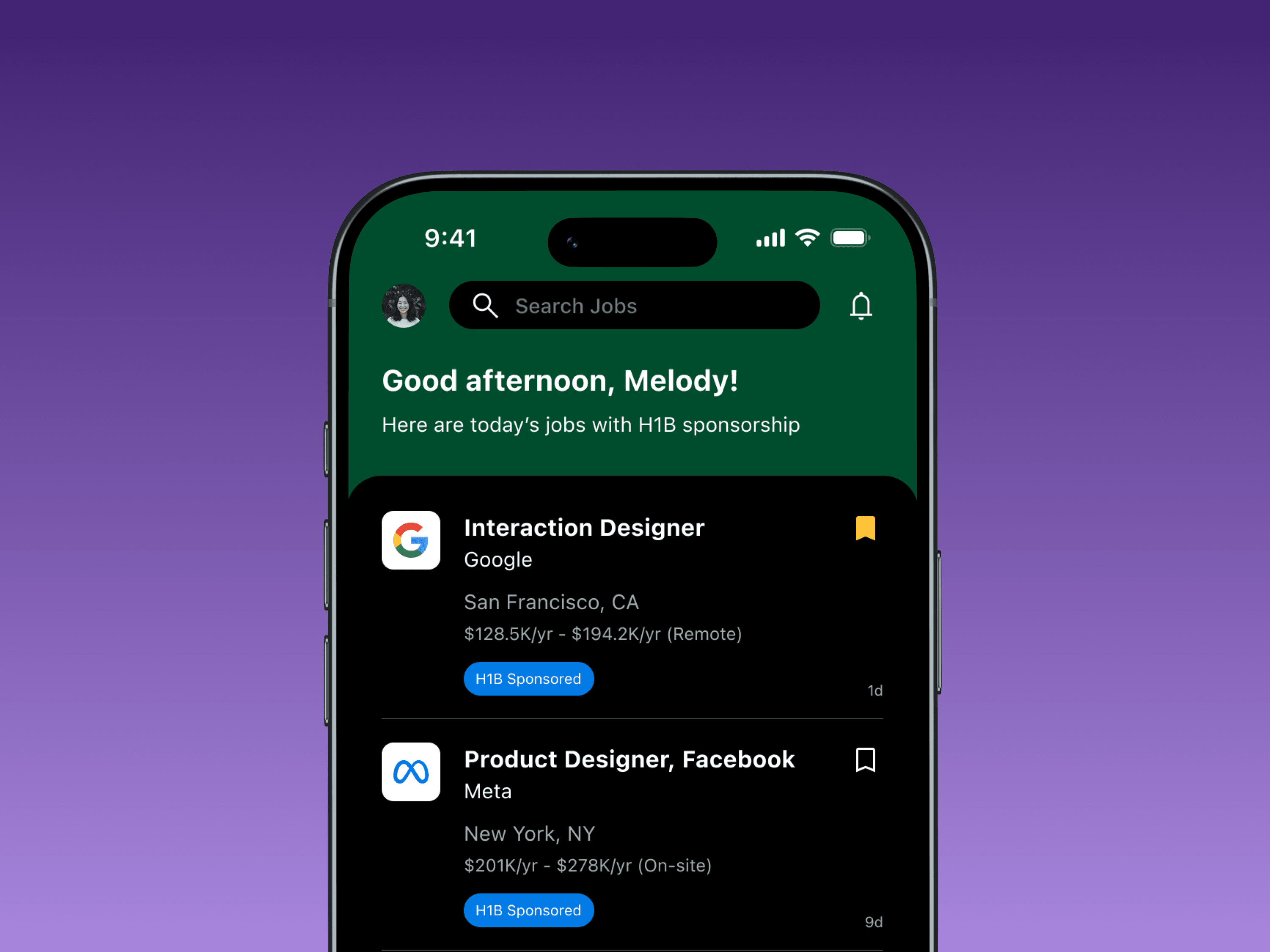
Haitou Job Hunter
Designing decision clarity for international job seekers navigating sponsorship constraints.

We redesigned Haitou’s job evaluation experience to better support international students navigating visa constraints.
The focus was on surfacing eligibility signals early and reducing decision uncertainty during evaluation.
Role:
UX Designer
Collaboration:
PM, UXR, Engineering
Timeline:
6 month
The Core Challenge
International students evaluate jobs differently.
Sponsorship eligibility determines whether a role is viable. Yet this constraint was not visible during the browsing and evaluation experience.
Final Peek
The redesigned experience brings sponsorship clarity into the evaluation flow.
Eligibility signals are surfaced early, domain terminology is clarified inline, and lightweight tracking preserves context without adding complexity.
Defining the Problem
Job evaluation on Haitou followed a generic browsing model.
For international students, however, sponsorship eligibility determines whether a role is viable.
Without clear signals, evaluating roles became a fragmented and uncertain process — often forcing users to leave the platform to verify information before applying.

What I Discovered
Through research, I identified three friction patterns driving drop-offs.
Users faced uncertainty around sponsorship eligibility, relied on fragmented external tools to verify information, and struggled with domain-specific terminology during evaluation.
These frictions slowed decision-making and reduced confidence before application.
Sponsorship Clarity
Sponsorship eligibility is surfaced directly within both job list and detail views, allowing users to quickly assess role viability before committing to an application. The badge was designed to remain noticeable without disrupting browsing hierarchy, ensuring clarity without visual dominance.
In-Context Clarification
Domain-specific terminology can be clarified inline without interrupting the reading flow. Rather than translating entire descriptions, explanations are contextual and optional, reducing cognitive load while preserving the integrity of the original content.
Application Status Tracking
Because most applications redirect to external ATS systems, the design supports lightweight status updates directly within the job context. This allows users to mark progress without replicating full workflow management inside the platform.
Progress Notes
Users can attach notes and update status over time, preserving decision context across evaluation and follow-up. The system was intentionally kept minimal to maintain focus on early-stage decision support rather than expanding into a comprehensive tracking tool.
Component System
The sponsorship configuration panel is designed as a scalable, reusable module within the browsing experience.
Its structure allows additional constraints or filters to be introduced without disrupting layout hierarchy, supporting future expansion while maintaining clarity.
Impact
31%
growth in daily active users
18.1%
increase in job application task completion
23%
reduction in external page exits
21%
higher apply initiation rate
Reflection
Building new features wasn’t the goal — reducing uncertainty was. Sponsorship signals, term clarification, and lightweight tracking worked because they removed the main reasons users left the platform during evaluation.
The main takeaway was restraint: design enough structure to preserve context, but avoid expanding into heavy workflow management.